Musee Des Beaux Arts and Landscape With the Fall of Icarus Comparison

"Musée des Beaux Arts" (French for "Museum of Fine Arts") is a poem written by Due west. H. Auden in December 1938 while he was staying in Brussels, Belgium, with Christopher Isherwood.[1] It was outset published under the title "Palais des beaux arts" (Palace of Fine Arts) in the Spring 1939 issue of New Writing, a modernist magazine edited past John Lehmann.[2] It next appeared in the collected volume of verse Another Time (New York: Random House, 1940), which was followed four months after by the English edition (London: Faber and Faber, 1940).[3] The poem's title derives from the Musées Royaux des Beaux-Arts de Belgique in Brussels, famous for its collection of Early Netherlandish painting. Auden visited the Musée and would have seen a number of works by the "Old Masters" of his second line, including Pieter Bruegel the Elder.
Synopsis [edit]
"Musee des Beaux Arts" by W.H. Auden describes, through the use of one specific artwork, the impact of suffering on humankind.[4]
Auden'due south gratuitous verse poem is divided into ii parts, the first of which describes scenes of "suffering" and "dreadful martyrdom" which rarely suspension into our quotidian routines: "While someone else is eating or opening a window or just walking dully / along." The 2nd half of the poem refers, through the poetic device of ekphrasis, to the painting Mural with the Fall of Icarus (c. 1560s), at the fourth dimension thought to exist past Bruegel, only now usually regarded as an early re-create of a lost work. Auden'south description allows united states of america to visualize this specific moment and instance of the indifference of others to a afar individual'south suffering, inconsequent to them, "how everything turns away / Quite leisurely from the disaster ... the white legs disappearing into the green." The disaster in question is the fall of Icarus, caused past his flying too shut to the sun and melting his waxen wings.
Auden achieves much in the poem, not only with his long and irregular lines, rhythms, and vernacular phrasing ("dogs go along with their doggy life"), merely as well with this balance betwixt what appear to exist general examples "Almost suffering" and a specific example of a mythical boy's fall into the sea. Auden scholars and art historians have suggested that the get-go function of the poem too relies on at least two additional paintings by Bruegel which Auden would take seen in the aforementioned 2d-flooring gallery of the museum.[5] These identifications are based on a not quite exact, just all the same evocative, series of correspondences between details in the paintings and Auden's linguistic communication. However, none testify a "martyrdom" in the usual sense, suggesting that other works are likewise evoked. The Bruegels are presented below in the society in which they announced to chronicle to Auden'due south lines.
Bruegel'south influence [edit]
lines 3–eight :

Bruegel'southward The Census at Bethlehem (catalogued at the Musée every bit "Le dénombrement de Bethléem")[half dozen] of 1566 was acquired by the Musée in 1902. Scott Horton noted that it would be a mistake to only look to the Icarus painting when explaining Auden'southward poem, for "The majority of the poem is clearly almost a dissimilar painting, in fact information technology's the museum's prize possession: The Census at Bethlehem."[7] The painting depicts Mary and Joseph middle right, she on a donkey bundled upwards for the snow of Bruegel's Flemish region, and he leading with a crimson hat and long carpenter's saw over his shoulder. They are surrounded by many other people: "someone else ... eating or opening a window or just walking dully / forth."[8] And in that location are children "On a pond at the edge of the wood" spinning tops and lacing on their skates.
lines 9–13 :
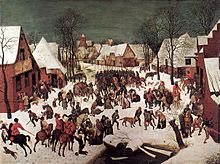
The Massacre of the Innocents (catalogued at the Musée every bit "Le Massacre des Innocents")[9] is a copy by Pieter Bruegel the Younger (1565–1636) of his father'southward original dated to 1565–7 (illustrated). The Musée acquired it in 1830. The scene depicted, again in a wintry Flanders landscape, is recounted in Matthew 2:16–18: Herod the Smashing, when told that a rex would be born to the Jews, ordered the Magi to alarm him when the king was found. The Magi, warned past an angel, did not and so, "When Herod realized that he had been outwitted by the Magi, he was furious, and he gave orders to kill all the boys in Bethlehem and its vicinity who were 2 years old and nether." In relation to the Demography painting and so we tin can see why the children of Auden'south verse form "did not peculiarly want it [the miraculous birth] to happen."
Both this scene and the before are used by Bruegel to make a political comment on the Spanish Habsburg rulers of Flanders at the time (annotation the Habsburg coat of artillery on the right forepart of the chief building in the Census and the Spanish troops in reddish in The Massacre arresting peasants and knocking downwardly doors).[ citation needed ] With respect to Auden'south language we can run across here "the dreadful martyrdom must run its class" (the innocent boys of Herod's wrath are traditionally considered the first of the Christian martyrs). We can meet 5 of those dogs of Auden's poem going about their business concern and an approximation of "the torturer's equus caballus / Scratches its innocent behind on a tree." Kinney says "Only i torturer's equus caballus stands near a tree, however, and he is unable to rub against information technology because another soldier, with a battering ram, is continuing between the horse and the tree ... Yet this must be the equus caballus Auden has in listen, since it is the merely torturer's equus caballus in Bruegel'south work, and the just painting with horses almost copse."[10]
lines 14–21 :
Landscape with the Fall of Icarus (catalogued at the Musée as "La Chute d'Icare")[9] was acquired in 1912. This is the simply known example of Bruegel's use of a scene from mythology, and he bases his figures and mural quite closely on the myth of Daedalus and his son Icarus as told by Ovid in his Metamorphoses eight, 183–235. The painting which Auden saw was thought until recently to be by Pieter Brueghel the Elder, though it is yet believed to be based on a lost original of his.[xi] The painting portrays several men and a ship peacefully performing daily activities in a charming landscape. While this occurs, Icarus is visible in the bottom right hand corner of the picture, his legs splayed at absurd angles, drowning in the water. There is also a Flemish proverb (of the sort imaged in other works past Bruegel): "And the farmer connected to plough..." (En de boer ... hij ploegde voort") pointing out the indifference of people to fellow men's suffering.[12]
Cultural legacy [edit]
Some years after Auden wrote this poem, William Carlos Williams wrote a verse form titled "Mural with the Fall of Icarus" about the same painting, and with a similar theme.
This poem and the painting Landscape with the Fall of Icarus appear side-by-side 22 minutes into the 1976 film, The Man Who Fell to Earth, starring David Bowie.
References [edit]
- ^ For the chronology of Auden'south composition of the poem see Edward Mendelson, Early on Auden, New York: Viking, 1981. pp. 346–8 and pp. 362–4.
- ^ See Andrew Thacker, "Auden and Little Magazines," in Tony Sharpe (ed.), W. H. Auden in Context, New York: Cambridge University Press, 2013. pp. 337–346, esp. p. 339.
- ^ For the full bibliography see B.C. Bloomfield and Edward Mendelson, West. H. Auden, a Bibliography, 1924–1969. 2nd edition. Charlottesville: University Press of Virginia, 1972. pp. twoscore–45.
- ^ Analysis of Musee des Beaux Arts by W.H. Auden
- ^ The first patently to note these other works was Kinney, Arthur F. (April 1963). "Auden, Bruegel, and 'Musée des Beaux Arts'". Higher English language. 24 (7): 529–531. doi:ten.2307/372881. JSTOR 372881.
- ^ See the online catalog of the Musée(search by artiste: Bruegel, or titre: Le dénombrement de Bethléem)
- ^ Scott Horton, "Auden's Musée des Beaux Arts," Harper'southward Magazine, xxx Nov 2008.
- ^ See the interesting discussion of the painting produced by the BBC as part of their Individual Life of a Christmas Masterpiece" series.
- ^ a b Musée
- ^ Kinney 1963, p. 530.
- ^ The Musée catalog reads: "On doute que l'exécution soit de Pieter I Bruegel mais la formulation lui est par contre attribuée avec certitude" ("It is doubtful if the execution is by Breugel the Elder, but the limerick can be said with certainty to be his"). Run into likewise: JSTOR 3780948 Lyckle de Vries, Bruegel'due south "Fall of Icarus": Ovid or Solomon?, Simiolus: Netherlands Quarterly for the History of Fine art, Vol. 30, No. 1/2 (2003), pp. 4–xviii. And for a scientific report of the sheet run into: JSTOR Mark J. Y. Van Strydonck et al., "Radiocarbon Dating of Canvas Paintings: Two Instance Studies", Studies in Conservation, Vol. 43, No. iv (1998), pp. 209–214.
- ^ Hunt, Patrick. "Ekphrasis or Not? Ovid (Met. viii.183–235 ) in Pieter Bruegel the Elder's Landscape with the Fall of Icarus". Archived from the original on 10 July 2009. Philolog Blog past Patrick Hunt, posted 9 Nov 2005.
External links [edit]
- Authorized text of verse form at Emory.edu
- Analysis of poem at PoetryPages
- Musee des Beaux Arts at the British Library
Source: https://en.wikipedia.org/wiki/Mus%C3%A9e_des_Beaux_Arts_(poem)

Mag-post ng isang Komento for "Musee Des Beaux Arts and Landscape With the Fall of Icarus Comparison"